American Fashion Gaithersburg Md Owner Melanie
Did you ever observe that the buttons on a shirt are on reverse sides for men and women? Curious to find out how World War 2 changed women's shaving habits? E'er thought most why men stopped wearing loftier heels? And what makes the fourth finger on our left mitt the "ring finger"?
These aren't merely random happenings or frivolous decisions by fashion magazines. Sometimes, state of war or other serious considerations influenced how we dress. In fact, there is a fascinating history behind many modern fashion trends. Read on to get the scoop behind some of our more puzzling way choices.
x Why Women Shave Their Legs

Women have not e'er shaved their legs. Indeed, under the reign of Queen Elizabeth I, who was a trendsetter of her time, women weren't expected to remove body hair. Instead, the style constabulary of that era dictated that women ought to remove eyebrows and hair from their foreheads to brand their faces appear longer. But leg hair? No need to shave.
So why did that alter?
The simple answer is Globe War II. During the war, the Us experienced a stockings shortage as the government redirected the utilize of nylon from stockings to war parachutes. For women, the nylon shortage meant having to bare their legs in public. To be deemed socially adequate, women began to shave their legs. Afterwards the war, as skirts became shorter, the trend stuck around.[one]
9 Why Girls Wear Pink And Boys Wear Blue

We have all been at that place. At a baby shower, the color of everything—from the tablecloths to the napkins—corresponds to the gender of the infant. Blue is for boys, and pink is for girls. But things were not always this way.
For centuries, children younger than six mostly wore flowing white dresses co-ordinate to Academy of Maryland historian Jo B. Paoletti, who wrote Pink and Blue: Telling the Girls From the Boys in America. "White cotton wool can be bleached," she says, which made information technology a practical pick.
In the 1900s, colors began to exist used as gender signifiers. But the colors did not mean what they do at present. For instance, a June 1918 article from a popular mode magazine alleged:
"The mostly accepted rule is pink for the boys and bluish for the girls. The reason is that pink, being a more decided and stronger color, is more than suitable for the boy, while blue, which is more fragile and squeamish, is prettier for the girl."[2]
Still, Paoletti says that these trends weren't specially widespread.
Effectually 1985, that all inverse with the ascension of prenatal testing, which allowed parents to decide the gender of the kid. As expectant parents learned the sex activity of their babies, they began to shop for "girl" or "boy" merchandise. Retailers noticed and individualized clothing to increment their sales.
For the most role, this trend appears to have stuck. Just Paoletti warns that it presents challenges for children who do not conform to the colors assigned to their gender.
8 Why Women's And Men's Buttons Are On Contrary Sides
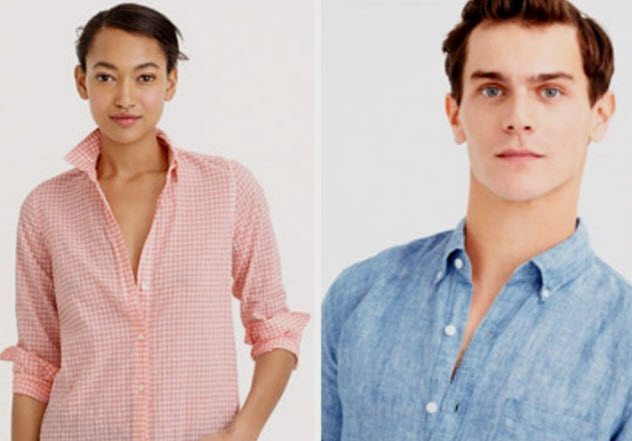
Odds are you ain a button-upwardly shirt. Take a await at which side the buttons are on. If you're a homo, chances are the buttons are on the right. If yous're a woman, you lot'll probable detect your buttons on the left.
In that location's an interesting historical reason for this. Melanie M. Moore, who created women's blouse brand Elizabeth & Clarke, explains: "When buttons were invented in the 13th century, they were, like near new technology, very expensive. [ . . . ] Wealthy women back so did not dress themselves—their lady'south maid did. Since most people were correct-handed, this made it easier for someone standing across from you to button your wearing apparel."[3]
As for men's shirts, fashion historian Chloe Chapin traces the fashion quirk to the military. "Access to a weapon . . . practically trumped everything," she says, noting that a firearm tucked inside a shirt would be easier to attain from the dominant side.
seven Why Men Stopped Wearing High Heels
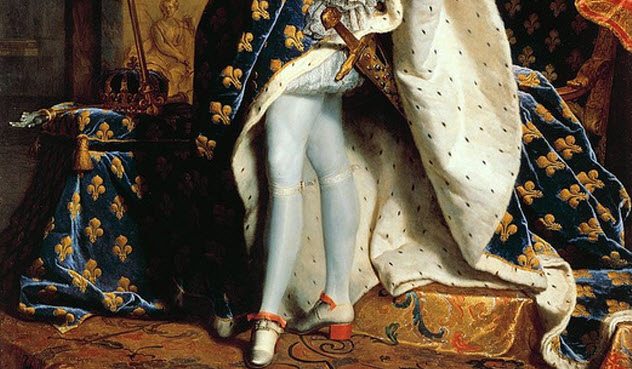
For generations, a pair of high heels has signaled feminine dazzler. Only before then, high heels were a staple in men'south closets.
Elizabeth Semmelhack of the Bata Shoe Museum in Toronto says, "The loftier heel was worn for centuries throughout the Near East as a grade of riding footwear. [ . . . ] When the soldier stood upwards in his stirrups, the heel helped him to secure his stance so that he could shoot his bow and pointer more than finer."[4]
About the 15th century, when Persian-European cultural exchange heightened, European aristocrats adopted loftier-heeled shoes as a symbol of their wealth. Co-ordinate to Semmelhack, elites have always used impractical clothing to showcase their privileged status.
Fast-forward to the Enlightenment era, which ostensibly brought with information technology an appreciation for the practical, and men began to renounce the impractical high heel. But sexism prohibited women from being viewed equally rational beings. Semmelhack suggests that the desirability of women was then seen in terms of irrational style choices like the high heel.
6 Why We Paint Our Nails
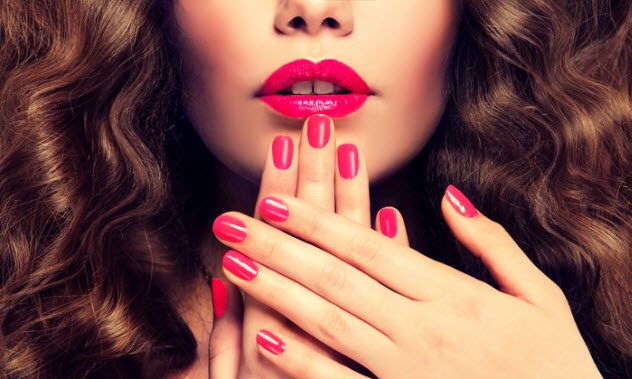
If you idea the manicure was a new phenomenon, y'all would be incorrect. Did you know that the world'due south oldest manicure set, made from solid gold dating to 3200 BC, is over 5,000 years onetime? The ancient Babylonians, who created that prepare, were known to have loved caring for their nails.
Ming Dynasty elites were too fans of painted nails, using a mixture of egg whites, gelatin, and prophylactic to dye their nails ruby-red and black. In England, Elizabeth I, a fashion icon of her day, was widely admired for her manicured nails and cute hands.[5]
Suzanne Shapiro, a researcher at The Costume Constitute at the Metropolitan Museum of Art in New York, says that long fingernails are impractical for hard labor, so they have tended to signal an elite social status.
Merely Shapiro admits that nail trends come and go. During the 1920s and '30s, the French manicure was in. Even so, during the 1960s, women preferred a more than natural look and rarely painted their nails.
5 Why Long Hair Became A Thing For Women

While hair trends take fallen in and out of fashion, one matter across cultures and millennia has remained adequately constant: the expectation that women would have long hair. We've seen it from the depiction of a long-haired Aphrodite to St. Paul'due south letter to the Corinthians, in which he wrote, "If a woman has long hair, it is a celebrity to her."
Kurt Stenn, author of Hair: A Homo History, says that women well-nigh e'er accept longer pilus than men. But why?
According to Stenn, a former professor of pathology and dermatology at Yale, hair is highly communicative. It sends messages about sexuality, religious beliefs, and power. In particular, he believes that long pilus can communicate wellness and wealth.
"To take long hair, you lot have to be healthy," Stenn says. "You have to eat well, accept no diseases, no infectious organisms, you have to have good rest and exercise." He adds, "To have long hair, you lot have to take your needs in life taken care of, which implies you lot accept the wealth to do it."[half dozen]
iv Why Some People Sag Their Pants
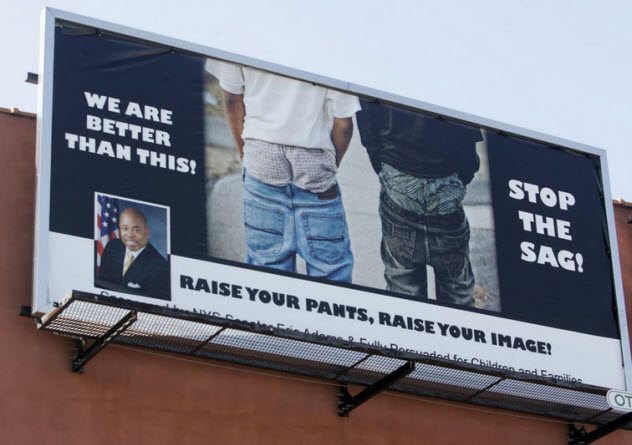
In 2014, the Ocala, Florida, city council passed an ordinance banning the practice of sagging (wearing i's pants below the waistline or, in some cases, the buttocks) on urban center-owned property. An offender would receive a $500 fine or half-dozen months in jail.
Similar bans have surfaced from New Jersey to Tennessee. The rationale behind this sort of legislation ordinarily goes something like this: Sagging represents a dangerous lack of cocky-respect and an embrace of gang culture. Information technology is a symbol of moral decline.
But how did sagging originate?
Co-ordinate to University of Massachusetts historian Tanisha C. Ford, the origins of sagging tin't be definitively traced. Only there are two leading theories. The first is that inmates, prohibited from wearing belts in prison, often sagged their uniforms. And so they continued the style after returning home. The 2nd theory is that convicts wore their pants depression equally a means of letting other prisoners know they were sexually available.[7]
3 Why We Habiliment Wedding Bands On The 'Ring Finger'
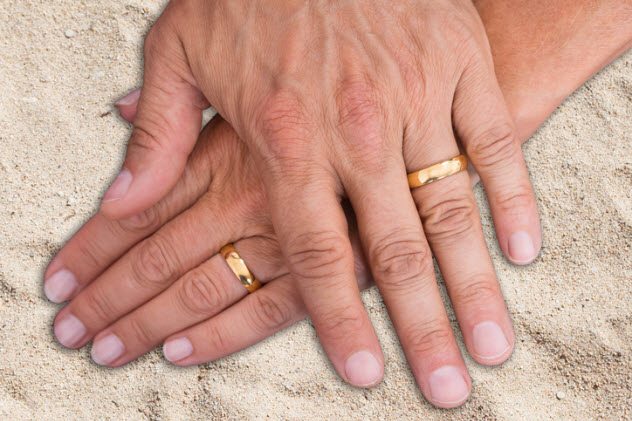
"With this band, I thee wednesday." The ring is slipped onto the fourth finger of the left mitt, and there you have it—a helpmate and groom! But have yous ever asked yourself why we slip our wedding ceremony bands onto the "ring finger"?
The tradition can be traced dorsum to Roman times. The Romans believed that a vein ran directly from the heart to the band finger. They named it the vena amoris ("vein of love"). Naturally, they idea it'd be plumbing equipment to place one'southward wedding band on that finger. Quite romantic!
By the style, mod science has proven that all fingers have a vein connection to our hearts.[8]
2 Why Men Wear Ties
 Ties. They don't keep us warm, aren't practical, and are ofttimes uncomfortable. So why practise men wear them?
Most neckwear historians concur that the necktie grew in prominence around the time of the Thirty Years' War in the 1600s. To fight the war, King Louis XIII employed Croatian mercenaries who wore a piece of cloth around their necks.
While these early neckties were largely functional—they tied the tops of their jackets—King Louis XIII liked them as sartorial adornments. Indeed, he fabricated these early neckties mandatory dress for formal gatherings and named them afterwards the Croatian mercenaries: cravate. To this twenty-four hour period, that means necktie in France.
Curiously, Croatia celebrates national Cravat Mean solar day every Oct 18. In 2003, they commemorated the vacation by tying an 808-meter (2,650 ft) tie effectually the historic Roman amphitheater in Pula.[nine]
one Why Women Shave Their Armpits
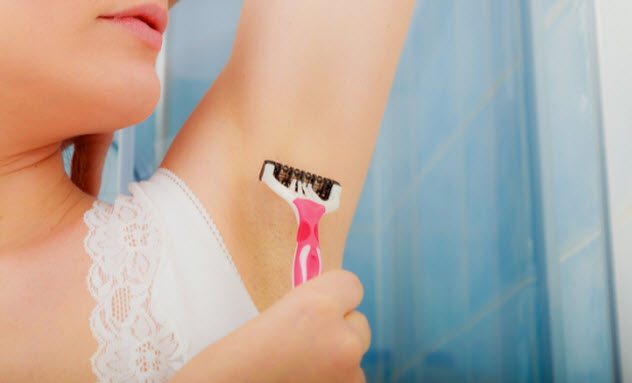
Women and men take had armpit pilus for millennia. And so why practise roughly 95 pct of women shave or wax their underarms? Who woke up one mean solar day and decided that women with armpit hair are unsightly?
Well, we tin can thank a 1915 Harper's Bazaar advertisement for that. Earlier so, women with bushy pits were the norm. But the advertisement told women that modern dancing and sleeveless dresses were the adjacent big thing and that "objectionable hair" was out. The ad featured a photograph of a young adult female in a sleeveless wearing apparel. Her arms were arched over her head, revealing perfectly clear armpits.
Within a few years and after an onslaught of advertisements promoting the trend, hairless armpits were a affair and natural hair was something embarrassing. Indeed, a 2013 Arizona State Academy written report measured disgust triggered by women with armpit hair. Information technology yielded responses like: "I think women who don't shave are a footling gross."[ten]
But natural, hairy pits might be making a comeback. 1 recent report found that 1 in four millennial women practise not shave or wax their pits.
Oscar is a Primary of Public Policy student at the Academy of Oxford. He is originally from Los Angeles, California.
0 Response to "American Fashion Gaithersburg Md Owner Melanie"
Post a Comment