World Men's Fashion Short Sleeve Button V-neck Color Block Muscle T-shirt

A shirt is a fabric garment for the upper body (from the neck to the waist).
Originally an undergarment worn exclusively by men, it has go, in American English, a catch-all term for a broad multifariousness of upper-body garments and undergarments. In British English, a shirt is more specifically a garment with a neckband, sleeves with cuffs, and a full vertical opening with buttons or snaps (North Americans would phone call that a "dress shirt", a specific type of collared shirt). A shirt can also be worn with a necktie nether the shirt collar.
History
The globe's oldest preserved garment, discovered past Flinders Petrie, is a "highly sophisticated" linen shirt from a First Dynasty Egyptian tomb at Tarkan, dated to c. 3000 BC: "the shoulders and sleeves have been finely pleated to give course-fitting trimness while allowing the wearer room to motion. The pocket-sized fringe formed during weaving along ane edge of the textile has been placed by the designer to decorate the neck opening and side seam."[ane]
The shirt was an particular of vesture that only men could article of clothing as underwear, until the twentieth century.[2] Although the women's chemise was a closely related garment to the men's, it is the men's garment that became the modern shirt.[iii] In the Middle Ages, information technology was a apparently, undyed garment worn adjacent to the pare and under regular garments. In medieval artworks, the shirt is just visible (uncovered) on humble characters, such every bit shepherds, prisoners, and penitents.[four] In the seventeenth century, men's shirts were immune to show, with much the same erotic import as visible underwear today.[five] In the eighteenth century, instead of underpants, men "relied on the long tails of shirts ... to serve the office of drawers.[6] Eighteenth-century costume historian Joseph Strutt believed that men who did not clothing shirts to bed were indecent.[7] Fifty-fifty equally late as 1879, a visible shirt with nothing over it was considered improper.[2]
The shirt sometimes had frills at the neck or cuffs. In the sixteenth century, men's shirts oftentimes had embroidery, and sometimes frills or lace at the cervix and cuffs and through the eighteenth-century long neck frills, or jabots, were fashionable.[eight] [9] Coloured shirts began to appear in the early nineteenth century, as can be seen in the paintings of George Caleb Bingham. They were considered casual wear, for lower-course workers just, until the twentieth century. For a gentleman, "to article of clothing a sky-blue shirt was unthinkable in 1860, but had go standard past 1920 and, in 1980, constituted the most commonplace effect."[10]
European and American women began wearing shirts in 1860, when the Garibaldi shirt, a ruby-red shirt as worn by the liberty fighters under Giuseppe Garibaldi, was popularized by Empress Eugénie of France.[eleven] [12] At the end of the nineteenth century, the Century Lexicon described an ordinary shirt as "of cotton wool, with linen bosom, wristbands and cuffs prepared for stiffening with starch, the neckband and wristbands being normally separate and adjustable".
The showtime documented appearance of the expression "To give the shirt off one's back", happened in 1771 as an idiom that indicates extreme desperation or generosity and is still in mutual usage. In 1827 Hannah Montague, a housewife in upstate New York, invents the detachable collar. Tired of constantly washing her husband'south unabridged shirt when just the collar needed it, she cut off his collars and devised a style of attaching them to the neckband after washing. Information technology wasn't until the 1930s that neckband stays became pop, although these early on accessories resembled tie clips more than the small collar stiffeners available today. They connected the neckband points to the necktie, keeping them in identify[13] [ better source needed ]
Types

- Camp shirt – a loose, straight-cut, short sleeved shirt or blouse with a simple placket forepart-opening and a "camp collar".
- Dress shirt – shirt with a formal (somewhat strong) collar, a total-length opening at the forepart from the collar to the hem (usually buttoned), and sleeves with cuffs
- White shirt – usually dress shirt which is white in colour
- Dinner shirt – a shirt specifically fabricated to exist worn with male evening clothing, e.m. a black tie or white tie.
- Guayabera – an embroidered dress shirt with iv pockets.
- Poet shirt – a loose-plumbing fixtures shirt or blouse with full bishop sleeves, usually with large frills on the front and on the cuffs.
- T-shirt – also "tee shirt", a coincidental shirt without a collar or buttons, made of a stretchy, finely knit fabric, ordinarily cotton, and normally brusk-sleeved. Originally worn under other shirts, it is now a mutual shirt for everyday vesture in some countries.[fourteen]
- Long-sleeved T-shirt – a T-shirt with long sleeves that extend to embrace the artillery.
- Ringer T-shirt – tee with a separate piece of textile sewn on as the collar and sleeve hems.
- Raglan T-shirt – a T-shirt with a raglan sleeve; a sleeve that extends in 1 piece fully to the collar, leaving a diagonal seam from underarm to collarbone.
- Halfshirt – a high-hemmed T-shirt
- Sleeveless shirt – a shirt manufactured without sleeves, or one whose sleeves take been cut off, besides called a tank elevation
- A-shirt or belong or singlet (in British English) – substantially a sleeveless shirt with large armholes and a large neck hole, oftentimes worn by labourers or athletes for increased movability.
- Camisole – woman'due south undershirt with narrow straps, or a similar garment worn alone (often with bra). As well referred to as a cami, shelf tiptop, spaghetti straps or strappy top
- Polo shirt (also tennis shirt or golf shirt) – a pullover soft collar brusk-sleeved shirt with an abbreviated button placket at the neck and a longer back than front end (the "tennis tail").
- Rugby shirt – a long-sleeved polo shirt, traditionally of rugged construction in thick cotton or wool, but often softer today
- Henley shirt – a collarless polo shirt
- Baseball game shirt (jersey) – usually distinguished by a three-quarters sleeve, team insignia, and flat waist seam
- Sweatshirt – long-sleeved athletic shirt of heavier fabric, with or without hood
- Tunic – primitive shirt, distinguished past two-slice structure. Initially a men's garment, is unremarkably seen in modern times being worn past women
- Shirtwaist – historically (circa. 1890–1920) a woman's tailored shirt (also chosen a "tailored waist") cut like a man'due south dress shirt;[15] in contemporary usage, a woman'south wearing apparel cut like a men'southward dress shirt to the waist, then extended into dress length at the bottom
- Nightshirt – often oversized, ruined or cheap light cloth undergarment shirt for sleeping.
- Halter top – a shoulderless, sleeveless garment for women. Information technology is mechanically analogous to an frock with a string effectually the back of the neck and across the lower back holding it in place.
- Top shirt – a long-sleeved collarless polo shirt
- Heavy shirt – a shirt with the heavy size that covers up nether the cervix
- Onesie or diaper shirt – a shirt for infants which includes a long back that is wrapped betwixt the legs and buttoned to the front of the shirt
- Tube acme (in American English) or telly (in British English) – a shoulderless, sleeveless "tube" that wraps the torso not reaching higher than the armpit, staying in place by elasticity or by a unmarried strap that is attached to the front of the tube
- Punishment shirts were special shirts made for the condemned, either those cursed supernaturally, such as the poisoned shirt that killed Creusa (daughter of Creon), the Shirt of Nessus used to kill Hercules, those used to execute people in ancient Rome, such as the Tunica molesta, and those used in church building heresy trials, such as the Shirt of Flame, or the Sanbenito
Parts of shirt
Many terms are used to describe and differentiate types of shirts (and upper-body garments in general) and their construction. The smallest differences may accept significance to a cultural or occupational group. Recently, (late twentieth century, into the twenty-first century) information technology has become common to apply tops equally a form of advertisement. Many of these distinctions utilize to other upper-body garments, such as coats and sweaters.
Shoulders and arms
Sleeves
Shirts may:
- take no covering of the shoulders or arms – a tube summit (non reaching higher than the armpits, staying in place past elasticity)
- accept simply shoulder straps, such every bit spaghetti straps
- comprehend the shoulders, but without sleeves
- have shoulderless sleeves, short or long, with or without shoulder straps, that betrayal the shoulders, merely cover the balance of the arm from the biceps and triceps downwardly to at least the elbow
- have short sleeves, varying from cap sleeves (roofing only the shoulder and not extending below the armpit) to half sleeves (elbow length), with some having quarter-length sleeves (reaching to a point that covers half of the biceps and triceps expanse)
- take three-quarter-length sleeves (reaching to a bespeak between the elbow and the wrist)
- have long sleeves (reaching a point to the wrist to a little beyond wrist)
Cuffs
Shirts with long sleeves may farther be distinguished by the cuffs:
- no buttons – a closed placket cuff
- buttons (or analogous fasteners such as snaps) – single or multiple. A single button or pair aligned parallel with the cuff hem is considered a button cuff. Multiple buttons aligned perpendicular to the cuff hem, or parallel to the placket establish a barrel cuff.
- buttonholes designed for cufflinks
- a French cuff, where the end half of the cuff is folded over the gage itself and fastened with a cufflink. This type of cuff has four buttons and a short placket.
- more than formally, a link gage – fastened like a French cuff, except is non folded over, but instead hemmed, at the border of the sleeve.
- asymmetrical designs, such every bit ane-shoulder, one-sleeve or with sleeves of different lengths.
Lower hem
- hanging to the waist
- leaving the abdomen button area blank (much more common for women than for men). See halfshirt.
- covering the crotch
- covering function of the legs (essentially this is a wearing apparel; notwithstanding, a piece of article of clothing is perceived either equally a shirt (worn with trousers) or as a clothes (in Western culture mainly worn by women)).
- going to the flooring (every bit a pajama shirt)
Trunk
- vertical opening on the front side, all the manner downward, with buttons or zipper. When attached with buttons, this opening is often called the placket front end.
- similar opening, but in dorsum.
- left and right front side not separable, put on over the head; with regard to upper front side opening:
- V-shaped permanent opening on the tiptop of the front end side
- no opening at the upper front side
- vertical opening on the upper front side with buttons or zipper
- men'south shirts are unremarkably buttoned on the right whereas women'south are usually buttoned on the left.[16]
Cervix
- with polo-neck
- with "scoop" neck
- with 5-cervix but no collar
- with plunging neck
- with open or tassel cervix
- with collar
- windsor collar or spread collar – a dressier collar designed with a wide distance betwixt points (the spread) to accommodate the windsor knot tie. The standard business concern collar.
- tab neckband – a collar with two small fabric tabs that spike together backside a tie to maintain neckband spread.
- fly collar – all-time suited for the bow tie, oftentimes only worn for very formal occasions.
- straight collar – or point collar, a version of the windsor collar that is distinguished by a narrower spread to better suit the iv-in-paw knot, pratt knot, and the half-windsor knot. A moderate dress collar.
- button-down collar – A collar with buttons that spike the points or tips to a shirt. The most casual of collars worn with a tie.
- ring collar – essentially the lower part of a normal collar, start used as the original collar to which a separate collarpiece was fastened. Rarely seen in modernistic fashion. Also casual.
- turtle neck collar – A collar that covers almost of the pharynx.
- without neckband
-
- V-neck no collar – The neckline protrudes down the chest and to a point, creating a "5"-looking neckline.
-
Other features
- pockets – how many (if any), where, and with regard to closure: non closable, just a flap, or with a button or zipper.
- with or without hood
Some combinations are not applicable, e.thou. a tube top cannot accept a collar.
Measures and sizes
The main measures for a jacket are:
- Shoulders
- Bust
- Waist
- Hip
- Sleeve
- Length, from the cervix to the waist or hip.
Sizes
- Asia Size Thousand = US/EU Size XS.
- Asia Size L = US/EU Size Due south.
- Asia Size XL = US/European union Size M.
- Asia Size XXL = Us/European union Size 50.
- Asia Size XXXL = US/European union Size Twoscore.
- Asia Size XXXXL = US/European union Size XXL.
Types of fabric
At that place are ii main categories of fibres used: natural fibre and human being-made fibre (synthetics or petroleum based). Some natural fibres are linen, the showtime used historically, hemp, cotton fiber, the virtually used, ramie, wool, silk and more recently bamboo or soya. Some synthetic fibres are polyester, tencel, viscose, etc. Polyester mixed with cotton wool (poly-cotton) is often used. Fabrics for shirts are called shirtings. The four main weaves for shirtings are plain weave, oxford, twill and satin. Broadcloth, poplin and stop-on-end are variations of the plain weave. After weaving, finishing tin exist applied to the material.
Shirts and politics
In the 1920s and 1930s, fascists wore unlike coloured shirts:
- Black shirts were used by the Italian fascists, and in Britain, Republic of finland and Germany and Croatia.
- Brownshirts were worn by German Nazis of the SA.
- The Blueshirts was a fascist movement in Republic of ireland and Canada, and the colour of the Portuguese Nacional Sindicalistas, the Spanish Falange Española, the French Solidarité Française, and the Chinese Blue Shirts Society.
- Light-green shirts were used in Hungary, Ireland, Romania, Brazil and Portugal.
- Camisas Doradas (golden shirts) were used in United mexican states.
- Ruby-red shirts were worn past the racist and antisemitic Bulgarian Ratniks.
- Argent Shirts were worn in the Usa of America.
- Grayness shirts were worn by members of the Fatherland League in Norway.
In improver, red shirts have been used to symbolize a diversity of different political groups, including Garibaldi'south Italian revolutionaries, nineteenth-century American street gangs, and socialist militias in Espana and Mexico during the 1930s.
Different colored shirts signified the major opposing sides that featured prominently in the 2008 Thai political crisis, with red having been worn past the supporters of the populist People's Power Political party (PPP), and xanthous existence worn by the supporters of the royalist and anti-Thaksin Shinawatra movement the People's Brotherhood for Democracy (PAD). Each side is usually referred to as the 'red shirts' and 'yellow shirts' respectively, though the afterwards opponents of the afterward Thaksin supporting groups take largely ceased wearing yellow shirts to protestation rallies.
In the UK, the Social Credit move of the thirties wore green shirts.
The party leaders of Dravidar Kazhagam in Bharat vesture only black shirts to symbolise atheism.
Industrial production
-

Shirt production line
-

Factory sewing
-

Shirts on a conveyor
-
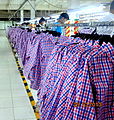
Shirts awaiting finishing
-

Kids shirts for quality checking
-

Manufacturer and buyer reviewing product
-

Clothes shirt
See also
- Cardigan (sweater)
- Descamisado
- Jermyn Street, home of the oldest English language shirtmakers
References
- ^ Hairdresser, Elizabeth Wayland (1994). Women's Piece of work. The first 20,000 Years, p.135. Norton & Company, New York. ISBN 0-393-31348-4
- ^ a b William L. Brown Three, "Some Thoughts on Men'south Shirts in America, 1750-1900", Thomas Publications, Gettysburg, PA 1999. ISBN ane-57747-048-6, p. 7
- ^ Dorothy K. Burnham, "Cutting My Cote", Royal Ontario Museum, Toronto, Ontario 1973. ISBN 0-88854-046-9, p. 14
- ^ C. Willett Cunnington and Phillis Cunnington, The History of Underclothes, Dover Publications Inc., New York 1992. ISBN 0-486-27124-ii pp. 23–25
- ^ C. Willett and Phillis Cunnington, The History of Underclothes, Dover Publications Inc., New York 1992. ISBN 0-486-27124-2 pp. 54
- ^ Linda Baumgarten, "What Apparel Reveal: The Language of Clothing in Colonial and Federal America", The Colonial Williamsburg Foundation, Williamsburg, Virginia, in association with the Yale University Press, New Haven, Connecticut 2002, ISBN 0-300-09580-5, p. 27
- ^ Linda Baumgarten, "What Clothes Reveal: The Linguistic communication of Clothing in Colonial and Federal America", The Colonial Williamsburg Foundation, Williamsburg, Virginia, in association with the Yale University Press, New Haven, Connecticut 2002, ISBN 0-300-09580-five, pp. twenty-22
- ^ C. Willet and Phillis Cunnington, "The History of Underclothes", Dover Publications Inc., New York 1992. ISBN 0-486-27124-2 pp. 36–39
- ^ C. Willet and Phillis Cunnington, "The History of Underclothes", Dover Publications Inc., New York 1992. ISBN 0-486-27124-2 pp. 73
- ^ Michel Pastoureau and Jody Gladding (translator), "The Devil'southward Cloth: A History of Stripes", Columbia University Press, New York 2001 ISBN 0-7434-5326-3, p. 65
- ^ Anne Buck, "Victorian Costume", Ruth Bean Publishers, Carlton, Bedford, England 1984. ISBN 0-903585-17-0
- ^ Immature, Julia Ditto, "The Rise of the Shirt Waist", Skillful Housekeeping, May 1902, pp. 354–357
- ^ "History of the Shirt :: Shirt Guide". Gant US. Retrieved 2016-09-29 .
- ^ "KYKU". kykuclothing.com.
- ^ For case, see Laura I. Baldt, A.G., Habiliment for Women: Option, Design and Structure, J.B. Lippincott Company, Philadelphia, PA 1924 (second edition), p. 312
- ^ Lewis, Danny (November 23, 2015). "Hither's Why Men'southward and Women's Clothes Push button on Contrary Sides". Smithsonian magazine . Retrieved December 6, 2021.
External links
 | Look upward shirt in Wiktionary, the complimentary lexicon. |
 | Wikimedia Eatables has media related to Shirts. |
- "Introduction to 18th-century fashion". Fashion, Jewellery & Accessories. Victoria and Albert Museum. 25 Jan 2011.
- "Introduction to 19th-century fashion". Mode, Jewellery & Accessories. Victoria and Albert Museum. 25 January 2011.
0 Response to "World Men's Fashion Short Sleeve Button V-neck Color Block Muscle T-shirt"
Post a Comment